
Delwar Hossain

Food adulteration is a serious problem in Bangladesh, with estimates suggesting that up to 70% of food items on the market are adulterated with harmful chemicals or artificial colors. According to a survey more than 80 per cent fruits, 60 per cent vegetables, 70 per cent rice, 60 per cent of both branded and open edible oil selling in the markets of Dhaka and elsewhere across the country are dangerously polluted now. Adulterants are added to food for the following reasons in a nutshell- to increase the bulk and reduce cost, with intent to defraud the consumer; to increase the quantity and make more profit; to increase the shelf life of food items; to attract the consumers; to increase the profit margin at the expense of the health of consumers.
Some of the most common food adulterants used in Bangladesh include:
· Formalin: A toxic chemical used to preserve food and make it look fresh. Formalin can cause cancer, liver damage, and respiratory problems.
· Carbide: A chemical used to ripen fruits artificially. Carbide can cause poisoning, headaches, and respiratory problems.
· Meat and bone meal: A byproduct of the meat industry that is sometimes used as a filler in poultry feed. Meat and bone meal can contain harmful bacteria and other contaminants.
· Artificial colors: Synthetic dyes that are used to make food look more appealing. Artificial colors have been linked to allergies, hyperactivity, and cancer.
· Solids like sands, chalk-powder, crushed rocks, seeds of similar crops, brick powder, wood powder, tamarind seed powder, detergent powder etc are mixed with grains or with powdery substances to increase the weight;
· Preservatives- As per Pure Food Rules, 1967 Preservatives means ‘any substance which is capable of inhibiting, retarding or arresting the process of fermentation, acidification or other decomposition or deterioration of food.’ A preservative is a substance that is added to food to prevent decomposition by microbial growth or by undesirable chemical.
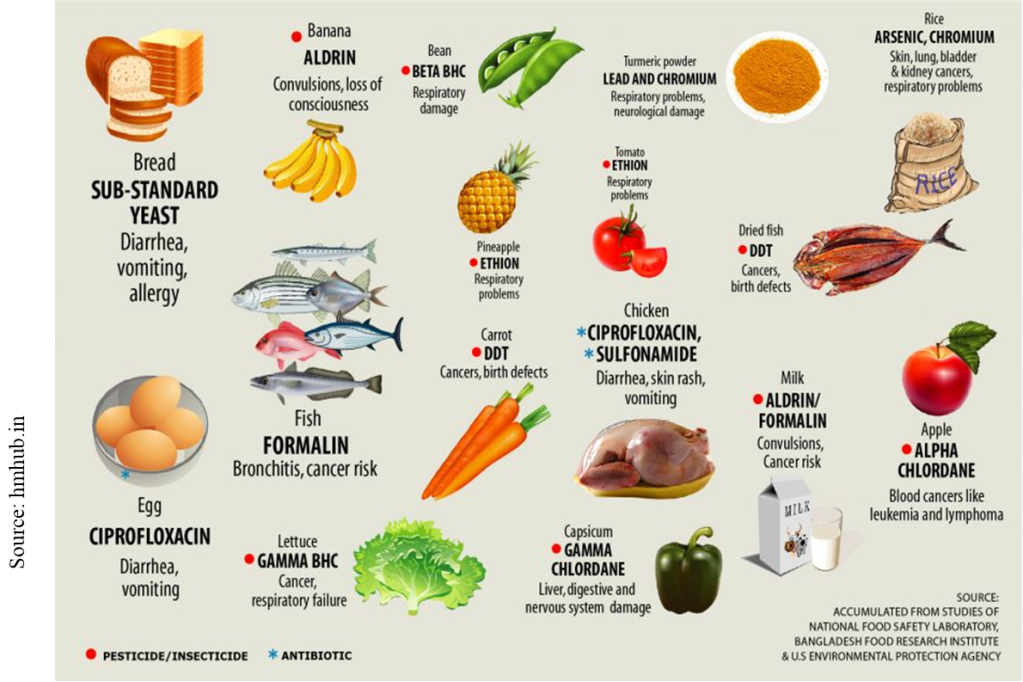
· Substitution of raw materials: Sometimes, cheaper or lower-quality raw materials are substituted for the real thing. For example, milk may be diluted with water, or vegetables may be dyed to make them look fresher.
Mislabeling: Food may be mislabeled to make it appear to be something that it is not. For example, honey may be labeled as “pure” when it actually contains sugar syrup.
Adulteration may also occur due to the removing, reducing or substituting of a fair part or any ingredient of the food item. For instance- the removing of milk fat from cow and buffalo milk takes place. Any food item (i.e. Sweetmeat, Sweetball, Kalakand, Channa, Curd, Yogurt, Cream etc) made of that kind of milk falls short of specified milk fat requirements and eventually results in adulterated food. . Besides, rye flour used in barley, bread and wheat flour, urea used in puffed rice and rice, Sulfuric acid used in milk, Oleomargarine or lard and DDT applied in dried fish cast long-term effects like nervous system disorder, depression, asthma, cardiac system, liver and kidney damage etc. Burnt engine oil is used to fry Jilapi, while artificial fragrance is applied on flowers.
Food adulteration is an increasingly recognized global public health problem. In low- and middle-income countries like Bangladesh, adulteration is difficult to detect and respond to. In a recent test conducted by Institute Of Public Health Bangladesh, adulteration has been found in all 43 consumer goods. The rate of the adulteration is 40 percent and nearly 100 percent adulteration found on 13 items among the 43 consumer goods tested (Rising Bd, 2017). According to the World Health Organization and Food & Agriculture Organization, nearly 45 lakh people in Bangladesh are being infected with various diseases every year. In a recent research of Ministry of Health, food adulteration has been marked as one of the main reasons for the rise of cancer, liver and kidney diseases. According to a study conducted in Dhaka city, 40-54% of daily consumed food was adulterated during 1995-2011. The consequences of food adulteration are two-fold for the consumers: the economic loss by paying more for lower-quality food items and the health hazards caused by consuming adulterated food.
The impact of food adulteration will be grave for the next generation. Adulterated food and the use of chemicals on foodstuffs are destroying our future generation. Though adulterated foods are dangerous for all, the impact of food adulteration falls most on children and aged people. Children are losing their disease resistance power for adulterated foods. They are losing their mental ability along with the damage of kidneys, livers and other organs. The children will be less intelligent and will lack good memory. People will frequently have to go to hospital. Their medical expenses will increase day by day which will cast a serious impact on the socio-economic conditions. So the entire nation is in a terrible risk due to food adulteration.
There are a number of factors that contribute to food adulteration in Bangladesh, including:
Lack of access to safe food: Many people in Bangladesh do not have access to safe food. This is due to poverty, lack of infrastructure, and poor distribution systems.
Lack of awareness: Many consumers are not aware of the dangers of food adulteration and do not know how to identify adulterated food.
Weak enforcement of food safety laws: The government of Bangladesh has a number of laws in place to regulate food safety, but these laws are often not enforced effectively. This is due to a lack of resources, corruption, and political interference.
Poverty: Many people in Bangladesh are poor and cannot afford to buy safe food. This makes them more likely to buy adulterated food, even if they know it is dangerous.
The government of Bangladesh has taken some steps to address the problem of food adulteration, including:
· Establishing the Bangladesh Standards and Testing Institute (BSTI): The BSTI is responsible for setting food safety standards and testing food products for compliance.
· Launching a mobile court campaign: The government has launched a mobile court campaign to crack down on food adulteration. Mobile courts are special courts that can be set up anywhere in the country to try cases of food adulteration.
· Enforcing food safety laws: The government of Bangladesh needs to enforce its food safety laws more effectively. This will require increasing resources for food safety inspection and enforcement, and reducing corruption.
· Raising awareness of food safety among consumers: The government and non-governmental organizations need to raise awareness of food safety among consumers. This can be done through education campaigns, public awareness programs, and food safety labeling.
Improving access to safe food: The government needs to improve access to safe food for all people in Bangladesh. This can be done by investing in infrastructure, improving distribution systems, and providing subsidies for safe food.

The problem of food adulteration in Bangladesh has serious consequences for public health. It can lead to food poisoning, cancer, and other health problems. It can also damage the economy by reducing consumer confidence in the food supply. However, more needs to be done to address the problem of food adulteration in Bangladesh. The government needs to strengthen enforcement of food safety laws and provide more resources to the BSTI. It also needs to educate consumers about the dangers of food adulteration and how to identify adulterated food.
Here are some tips for consumers to avoid adulterated food in Bangladesh:
· Buy food from reputable sources: Avoid buying food from street vendors or small shops. Instead, buy food from supermarkets or large grocery stores.
· Look for the BSTI logo: The BSTI logo is a guarantee that the product has been tested and meets food safety standards.
· Be suspicious of cheap food: If the price of a food product is too good to be true, it probably is. Adulterated food is often sold at a lower price than safe food.
Ask questions: If you are not sure whether a food product is safe, ask the shopkeeper where it was made and how it was stored.
By following these tips, consumers can help to reduce their risk of consuming adulterated food in Bangladesh. Food safety has become a serious public health concern in Bangladesh. There is no denying that the country has a number of laws, regulations and policies in place to ensure food safety, hitherto, ensuring safe food remains a major challenge in the country due to poor application of the existing laws. People have a right to safe food. As Bangladesh has already achieved sufficiency in production the government now should act to ensure food safety. Food adulteration was considered a major health threat. The government could act on food adulteration prevention if provided credible population-based data on disease burden, a model food sampling and testing protocol, a model for inspections, organizational strengthening and training, example social and behavioral change communications with estimated costs.
Author is an Graphic Designer & Photographer (denimdelwar@gmail.com)
 envreview.com